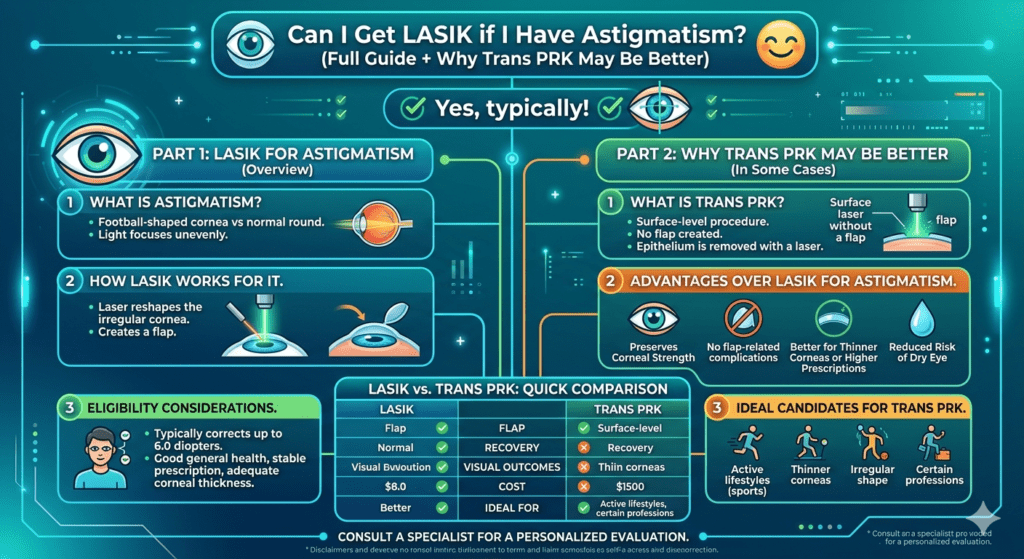
Can I Get LASIK if I Have Astigmatism? (Full Guide + Why Trans PRK May Be Better)
If you’ve been told you have astigmatism, one of the first questions you’re likely asking is: “Can I get LASIK if I have astigmatism?” The short answer is yes—many people with astigmatism are candidates for laser eye surgery. However, the better question is: is LASIK the best option for you?
In many cases, especially for patients with higher prescriptions, thinner corneas, or irregular astigmatism, Trans PRK (Transepithelial PRK) may actually be the safer and more effective choice.
What Is Astigmatism?
Astigmatism is a common refractive error caused by an irregularly shaped cornea. Instead of being perfectly round, the cornea is shaped more like a football, which causes:
Blurry or distorted vision
Difficulty seeing at night
Eye strain or headaches
Halos or glare around lights
It often occurs alongside nearsightedness (myopia) or farsightedness (hyperopia).
Can You Get LASIK with Astigmatism?
Yes—LASIK can treat astigmatism by reshaping the cornea to correct how light enters the eye.
LASIK works well for:
Mild to moderate astigmatism
Patients with thick, healthy corneas
Stable prescriptions
But LASIK may NOT be ideal if you have:
Thin corneas
Irregular astigmatism (e.g., early keratoconus)
Dry eyes
Higher prescriptions
Active lifestyles (risk of flap complications)
This is where Trans PRK becomes a superior alternative.
Why Trans PRK Is Better Than LASIK for Astigmatism
Trans PRK is an advanced, no-touch, no-flap laser procedure that corrects vision directly on the surface of the eye.
Key Advantages of Trans PRK:
1. No Flap = Safer Procedure
LASIK requires creating a corneal flap, which can weaken the eye structure.
Trans PRK eliminates this step entirely, preserving corneal strength.
2. Better for Thin Corneas
Many patients are told they are “not candidates” for LASIK due to thin corneas.
Trans PRK is often the ideal solution in these cases.
3. More Precise for Astigmatism
Trans PRK uses advanced laser mapping to accurately correct irregular corneal shapes, making it especially effective for astigmatism.
4. Lower Risk of Long-Term Complications
No flap dislocation risk
Lower incidence of dry eye symptoms
More stable long-term outcomes
5. Ideal for Active Lifestyles
Athletes, first responders, and military personnel often prefer Trans PRK because there is no flap that can shift with trauma.
LASIK vs Trans PRK (Quick Comparison)
| Feature | LASIK | Trans PRK |
|---|---|---|
| Corneal flap | Yes | No |
| Corneal strength | Reduced | Preserved |
| Suitable for thin corneas | No | Yes |
| Dry eye risk | Higher | Lower |
| Recovery speed | Faster initial | Slightly longer |
| Long-term stability | Good | Excellent |
Who Is the Best Candidate for Trans PRK?
You may be an ideal candidate if you have:
Astigmatism (mild to severe)
Thin or borderline corneas
Dry eye symptoms
Irregular corneal shape
An active lifestyle or high-impact job
Infographic: LASIK vs Trans PRK for Astigmatism
👁️ ASTIGMATISM + LASER EYE SURGERY OPTIONS
Can LASIK treat astigmatism?
✔ Yes — but not always the best choice
🔴 LASIK
Requires corneal flap
Not ideal for thin corneas
Higher dry eye risk
Less suitable for irregular astigmatism
🟢 TRANS PRK
No flap (safer structure)
Works on thin corneas
More precise for astigmatism
Lower long-term complication risk
Preferred for active lifestyles
⭐ BOTTOM LINE
Trans PRK = safer, stronger, and often more accurate for astigmatism patients
Is Trans PRK Right for You?
While LASIK is widely known, it’s not always the best or safest option—especially for patients with astigmatism. A personalized assessment is essential to determine which procedure will give you the best outcome.
The most important factors include:
Corneal thickness
Shape of your astigmatism
Eye health
Lifestyle needs
Final Thoughts
So, can you get LASIK if you have astigmatism?
Yes—but you shouldn’t assume it’s your best option.
For many patients, Trans PRK offers a safer, more advanced, and more precise solution, particularly when treating astigmatism.