
Trans PRK Success Rate: What Patients Need to Know Before Laser Eye Surgery
When researching laser eye surgery, one of the most common questions patients ask is about the trans PRK success rate. Trans PRK (Transepithelial Photorefractive Keratectomy) is widely regarded as one of the safest and most advanced forms of surface laser vision correction available today. But how successful is it really?
In this article, we break down the trans PRK success rate, what “success” actually means in medical terms, and why this procedure continues to grow in popularity among patients who are not candidates for LASIK.
What Is Trans PRK?
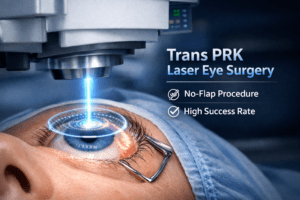
Trans PRK is a no-cut, blade-free laser eye surgery that corrects vision by reshaping the cornea using an excimer laser. Unlike LASIK, there is no corneal flap created, and unlike traditional PRK, the epithelium (outer layer of the cornea) is removed entirely by laser rather than alcohol or manual instruments.
Because of this, trans PRK is often considered the least invasive form of laser vision correction.
Trans PRK Success Rate Explained
The trans PRK success rate is exceptionally high when performed on properly selected patients by an experienced surgeon.
Clinical Success Rates
- Over 95–98% of patients achieve 20/20 vision or better
- More than 99% reach legal driving vision (20/40 or better)
- Enhancement rates are very low, often below 2–3%
These outcomes are comparable to — and in some cases exceed — traditional LASIK, especially for patients with thinner corneas or higher prescriptions.
What Defines “Success” in Trans PRK?
When doctors discuss the trans PRK success rate, they look at several important factors:
1. Visual Acuity
Most patients achieve sharp, clear vision without glasses or contact lenses.
2. Long-Term Stability
Because no corneal flap is created, trans PRK offers excellent long-term stability with a lower risk of regression.
3. Safety Profile
Trans PRK has one of the lowest complication rates in laser eye surgery.
4. Patient Satisfaction
Patient satisfaction rates consistently exceed 95%, particularly among those who were not LASIK candidates.
Why Trans PRK Has Such a High Success Rate
Several factors contribute to the strong trans PRK success rate:
- No corneal flap (eliminates flap-related complications)
- Greater corneal strength after surgery
- Reduced dry eye risk compared to LASIK
- Advanced laser precision
- Ideal for thin corneas, high prescriptions, and active professions
This makes trans PRK especially popular among police officers, military personnel, athletes, and patients seeking the safest possible option.
You may be an excellent candidate if you:
- Have thin or irregular corneas
- Are at higher risk for eye trauma
- Have been told you’re not eligible for LASIK
- Want a no-cut laser eye surgery
- Have mild to high myopia, hyperopia, or astigmatism
A comprehensive eye exam is essential to determine candidacy and maximize the trans PRK success rate.
Trans PRK vs LASIK: Success Rate Comparison
| Procedure | Success Rate (20/20 or Better) | Flap-Free | Corneal Strength |
|---|---|---|---|
| Trans PRK | 95–98% | ✅ Yes | Excellent |
| LASIK | 94–97% | ❌ No | Reduced |
While both procedures are highly successful, trans PRK offers added safety benefits, particularly for patients with borderline corneas.
Recovery and Visual Outcomes
Although trans PRK has a slightly longer recovery than LASIK, final visual outcomes are equally strong.
- Initial healing: 3–5 days
- Functional vision: 1–2 weeks
- Final vision clarity: 4–12 weeks
Patients often report that once healing is complete, their vision is exceptionally sharp and stable.
Is Trans PRK Worth It?
If safety, long-term stability, and eligibility are your top priorities, trans PRK is one of the most reliable laser eye surgeries available today. The consistently high trans PRK success rate reflects decades of clinical data and technological advancement.